
SFCR Agentic Workflow
Deploys a **multi-agent AI orchestration system** with six specialized agents that autonomously collect financial data, validate regulatory compliance, generate report narratives, perform quality assurance, and produce XBRL outputs. Human-in-the-loop checkpoints ensure accuracy while significantly reducing report generation time.
Problem Statement
The challenge addressed
Solution Architecture
AI orchestration approach
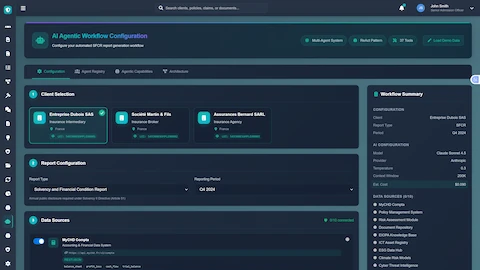
SFCR Workflow Configuration - Client selection, report type setup, and data source connections for automated report generation
Agent Execution Monitor - Real-time view of AI agents orchestrating data collection, compliance validation, and report generation tasks
Human-in-the-Loop Review - Quality validation interface showing section approvals, compliance checks, and accuracy metrics
Workflow Complete - Executive summary displaying SFCR generation results, time savings, cost reduction, and quality scores
AI Agents
Specialized autonomous agents working in coordination
Orchestrator Agent
Complex SFCR generation requires **coordinating multiple specialized tasks** across data collection, compliance checking, narrative generation, and formatting—with dependencies that must be managed to ensure correct sequencing.
Core Logic
Acts as the **master coordinator** that delegates tasks to specialized agents, manages workflow state transitions, handles inter-agent communication, monitors progress across all phases, and triggers escalations when agents encounter blockers or low-confidence scenarios. Uses a sitemap-based task graph to ensure proper execution order.
Data Collector Agent
SFCR reports require **consolidating data from disparate sources**—financial databases, policy management systems, risk registers, and actuarial models—which is time-consuming and error-prone when done manually.
Core Logic
Autonomously queries connected data sources using specialized tools (`query_financial_database`, `query_policy_database`, `get_risk_assessments`). Validates data completeness, applies transformation rules, and produces structured datasets with data lineage tracking for downstream agents.
Compliance Analyzer Agent
Solvency II mandates strict adherence to **Pillar 1 quantitative requirements** (SCR, MCR, technical provisions) and EIOPA guidelines. Manual compliance verification is resource-intensive and risks regulatory penalties for non-compliance.
Core Logic
Validates all financial calculations against Solvency II requirements using `validate_solvency_calculation` and `check_regulatory_compliance` tools. Cross-references EIOPA guidelines, identifies compliance gaps, generates validation reports with specific references to regulatory articles, and flags items requiring human review.
Report Generator Agent
SFCR narrative sections require **professional financial writing** that accurately represents complex quantitative data, explains risk management strategies, and maintains consistency with regulatory terminology across hundreds of pages.
Core Logic
Generates report sections using **RAG-augmented content creation** with `search_regulatory_knowledge` tool. Retrieves relevant templates, precedent language, and regulatory guidance to produce narratives. Each section includes quality scoring for readability, accuracy, and compliance alignment.
Quality Reviewer Agent
Report quality assurance requires **cross-validating multiple sections** for internal consistency, numerical accuracy, and completeness—a tedious process when performed manually across lengthy documents.
Core Logic
Performs automated validation using `cross_validate_sections` and `calculate_quality_score` tools. Checks for numerical consistency between tables and narratives, identifies gaps in required disclosures, validates terminology usage, and produces quality metrics with specific improvement recommendations.
XBRL Specialist Agent
Regulatory submission requires **XBRL-formatted instance documents** adhering to EIOPA taxonomies. Manual XBRL tagging is highly technical and error-prone, with validation failures causing submission rejections.
Core Logic
Transforms validated report data into XBRL format using `generate_xbrl_tags` and `validate_xbrl_instance` tools. Maps financial facts to correct taxonomy elements, generates instance documents, runs EIOPA validation checks, and produces submission-ready files with comprehensive error logs.
Technical Details
Worker Overview
Technical specifications, architecture, and interface preview
System Overview
Technical documentation
The SFCR Agentic Workflow is an enterprise-grade AI system that automates the end-to-end creation of Solvency and Financial Condition Reports. It employs the **ReAct (Reasoning + Acting) pattern** where agents iteratively think, act, observe, and reflect. The workflow progresses through seven phases: Configuration, Data Ingestion, Analysis, Generation, Validation, Human Review, and Finalization. Each agent maintains state (idle, thinking, acting, waiting, completed, error), tracks token usage and cost, and provides real-time observability through reasoning history and tool call logs. The system supports escalation to human experts when confidence drops below thresholds or regulatory ambiguity arises.
Tech Stack
What this worker runs on
Modern frontend with RxJS state management
Multi-LLM gateway supporting Claude, GPT-4, Azure OpenAI, and Amazon Bedrock
Integration with financial databases, policy management systems, and risk registers
XBRL taxonomy libraries for EIOPA-compliant output generation
Human review workflow with approval staging and audit logging
Architecture Diagram
System flow visualization